
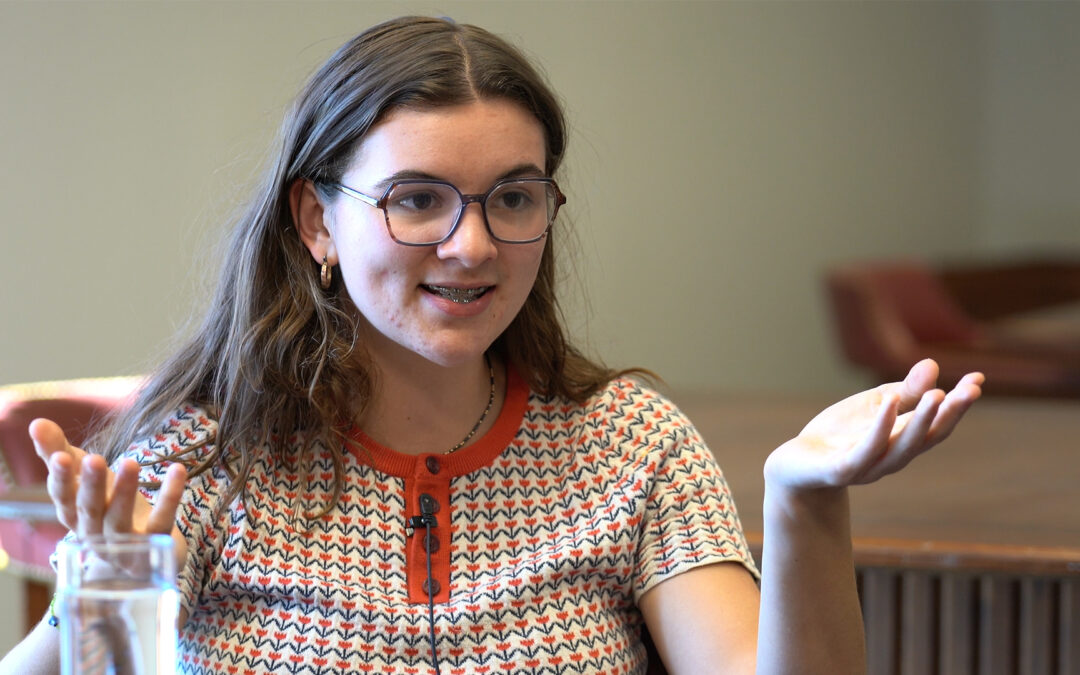
Transcript
Alvin Blount: Welcome, Ellie.
Ellie Graham: Hi.
Alvin Blount: We are so glad to have you to come into the diocesan house and tell us your story. I’ve been looking forward to this for quite some time, really ever since we met sometime last year. You were a junior, I think, in school. So, Ellie, tell us about yourself.
Ellie Graham: Well, I just turned 18 a few weeks ago. I’m from Maryville. I go to the Church of the Good Samaritan here in Knoxville, and I’ve always been an Episcopalian. I’m a student. I’m an artist. I’m a runner. And that’s pretty much all there is to do with me.
Alvin Blount: And I know art is in your DNA because I think your grandmother was an artist. Am I right?
Ellie Graham: Yes, she was.
Alvin Blount: Great. Great. Tell us about your faith and how you connect with God.
Ellie Graham: Well, I obviously grew up in the Episcopal Church, but I moved to Good Samaritan when I was about 12, I think. I think that really marked a period of journey within my life. I would say that so much of my involvement has to do with Sinéad and her mentorship throughout my life. I think that so much of how involved I am really comes from the leaders who I’ve interacted with, especially. The period that I started going to Good Sam was a very transformative time. So being with the other older kids in the youth group who really were great leaders and still are great leaders, I think, really inspires me. Good Sam does a great job of supporting its youth, like so many churches here. The most memorable would have to be the mission trips that I went on with Sinéad, especially, going throughout the years. I think we went to Montgomery, Alabama. That was the first one I went on and we visited the EJI down there, and that is really such a fond memory that I have because I really couldn’t imagine before that, you know, incorporating church and such a striving for social justice. That was really like the first time I had really seen that and really been involved with it and carrying that out. And so I would say that that is where I really feel the most connected to God is when I’m doing volunteer work and when I’m learning from other people, just being able to see, you know, Jesus’s teachings and practice is really empowering.
Alvin Blount: Great for you. Tell us how ENTyouth [sic, ETNyouth] plays a role in your faith journey.
Ellie Graham: Yeah. So. I think. Really the first time I started interacting with the diocese at a larger level would have to be when I went to the National Acolyte Festival in maybe 2017, 2016 or 2017. It was definitely pre-COVID. But I went down there with Jody and Gracie. Just being able to be in D.C. and be with all of these kids who were from Chattanooga and Cleveland, who I’d never really met before. Just being able to be in that city with them was amazing. We definitely took advantage of D.C. while we were at the National Cathedral. One thing we did was, I think, a few of us went to a protest at the Capitol building, which was insanely empowering to me as a 14 year old. After that, I started going to so many diocesan things, and especially getting involved with Happening over the past few years with the help of Caroline and just being able to really position myself as a leader within the diocese and make so many new friends and tweak things and keep traditions how they were and really just expand on everything that we have going on has been really amazing. And so, being able to really put that into action and being rector at the last Happening or two Happenings ago was just an incredible way for me to, I think, give back to the diocese. I’m just very excited for where our diocese is heading, especially this summer: going on the pilgrimage and the amount of youth leadership that I’ve really seen grow coming out of the challenging past three years that we’ve had. I think that that is really spiritually fulfilling.
Alvin Blount: Tell us about Happening. What is Happening about for those who might not have heard of it? And tell us your role because I think you were involved in Happening this past weekend. So, tell us about your your role in it and what is it all about.
Ellie Graham: Yeah. So, Happening is a really big I would call it a coming of age event almost for Episcopalians and it’s for high school youth. So going to our conference center for about three days. And really it’s centered around, you know, what can you become in your adolescence in terms of a faith community and getting closer to God. One of my favorite parts of Happening is that it’s completely run by youth for the youth that are there. And so the whole youth team puts in so much work just to make sure that the weekend is full of moments of growth. I can’t say much about the weekend just because of the way that it’s set up, but it is definitely it’s a series of talks that we have that really try to empower the participants there and also the team just to grow spiritually. Last November I was the lay rector of the event. So, I got the opportunity to partner with our diocesan coordinator and plan the whole thing. And that was really beautiful to just kind of choose my own theme and choose the music and see it all play out. This past weekend, one of my close friends from Chattanooga was able to be the rector, and I was just kind of being their support to him. That was also awesome because I feel like every Happening is just a whole new way, even though most of the events are kind of structured similarly to just kind of expand our idea of God for everyone involved.
Alvin Blount: Great. As a younger delegate to the General convention, what do you hope to influence or change?
Ellie Graham: Right. So, I’m really excited to go to General Convention for the first time. I think I have a different perspective just because I was a youth delegate last summer. Obviously I didn’t get to attend the actual event. But, you know, I was able to speak to so many youth who are also delegates, but also just, you know, coming back here and asking youth what they really want to see happen and kind of being able to explain general convention to them. From my own perspective. And I feel like I feel like I have a very in-depth idea of general convention, thanks to the training that I went through during my youth training. But I think going in, it’s very clear that the youth are passionate about racial reconciliation and LGBTQ and trans inclusion within the church, sustainability that the church is already working towards. Personally, some of the things that I started working on for convention dealt with a lot of transgender issues and indigenous issues, which thankfully I think we’re targeted at the last convention, but certainly we’ll still be working towards at this next upcoming one in 2024. And so I think being able to be a youth, but also understand that I have a lot to learn from everyone in this diocese that will be going with me is really important. And also one of the most important things for me as a youth who has a little bit more of a I guess platform within the diocese is kind of bridging that gap in church generally, generationally between those in this diocese and in the church as a whole. I’m working towards that with EYE as well. But it’s important to me that, you know, we get all of the voices from the oldest to the youngest in the room.
Alvin Blount: So what are your future plans?
Ellie Graham: Well, I’ll be going to college in the fall. I’m not entirely sure yet, but fingers crossed. I have a specific question mind, and I’ll probably be majoring in history and religious studies and minoring in some data analysis fields, thanks to actually an experience that I had a Good Sam a few summers ago, we had a program at The Bottom Knoxville with the Archival Research center.
Alvin Blount: One of my favorite bookstores is The Bottom. Love it.
Ellie Graham: That was just a great introduction to the field of archival research and ever since then I’ve been so influenced to get involved with that. I would love to work within the church as an adult. But also that’s just one of the passions that I have that I think is really influenced by the values of the Episcopal Church: seeking justice through truth and being able to be a truth teller through reading and through analysis and through really thoughtfully looking at history.
Alvin Blount: Where are you in high school now in Maryville?
Ellie Graham: I go to Maryville High School and I’m a senior.
Alvin Blount: A senior they’re not much longer. You’ll be graduating month after next. Congratulations to you.
Ellie Graham: Thank you.
Alvin Blount: What has been your favorite studies at Maryville?
Ellie Graham: Oh, I would have to say either my sociology class or just kind of my general history courses. I’ve been really lucky to have some amazing history teachers. Actually, the same person that taught me sociology also was my U.S. history teacher and my European history teacher. And he’s really been just a huge mentor in my life who has just always really pushed me to be a good history student. And he’s been just always there throughout the past years that I’ve been at school and definitely has made me want to continue studying history.
Alvin Blount: Great. Tell us about your cross-country activities.
Ellie Graham: Yes. So, I have been running for about six or seven years and I really like running. I really like it not only for the competition-I’m not the most competitive person-but I also really like the community that it fosters. I love being active, especially just because Maryville, I think, is the perfect place to do an activity like that. I plan on running in college. I think that’ll be a great way to meet new people and explore the city and just kind of have my own community within the community that I’m in.
Alvin Blount: Good for you. Well, we are so fortunate to have you as so active in our diocese, so proud of your work: your work with social justice, equity and inclusion, and your work with the General Convention and with the convention here in East Tennessee. So you were very active with that too. And I cannot thank you enough for telling your story for us, for our storytelling initiative. And it’s just always a pleasure to be with you and to see your work. And thank you so much.
Ellie Graham: Thank you so much.